
Cylinder Manufacturer · Morbi, Gujarat
Seamless CO₂ cylinders for fire extinguishers.
Rakshitam Industries manufactures seamless steel cylinders for CO₂ fire extinguishers. Each body starts as a single seamless 37Mn steel pipe, closed by hot spinning at both ends — there is no welded joint anywhere in the pressure boundary. Every cylinder is normalised, hydrostatically tested by the water-jacket method and hard-stamped before dispatch.
- 01Machined neck — taper gas thread to IS 3224
- 02Seamless body — 37Mn steel, one continuous pipe
- 03Hot-spun base — closed by spinning, never welded
- 04Normalised — 880–920 °C, air cooled
- 05Hydrostatic tested — every cylinder, not a sample
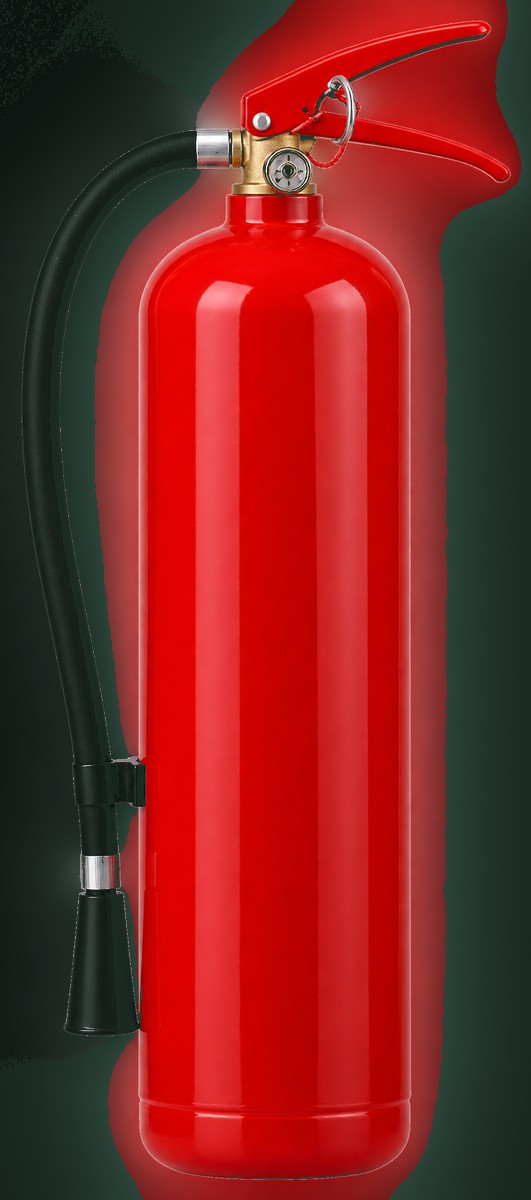
Valve, hose and horn are fitted by the equipment maker.
Approvals first — a serious buyer checks these before anything else, so here they are.
Product Range
Five sizes, one build standard.
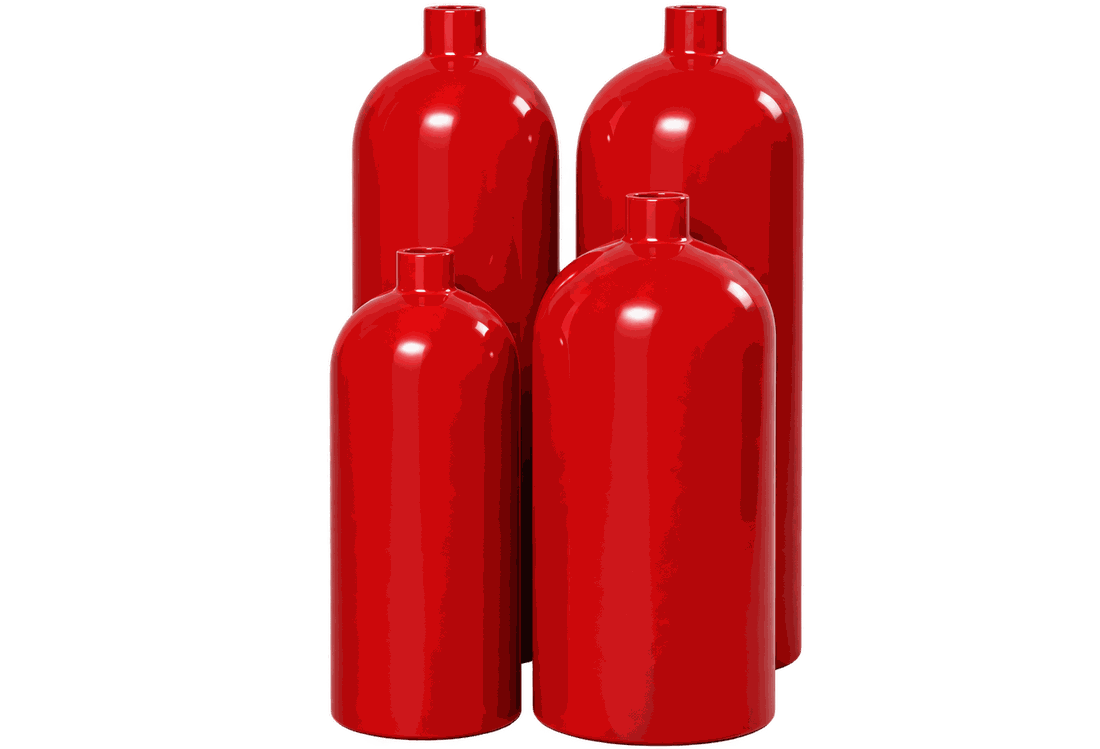
Every Rakshitam cylinder is built the same way — one seamless 37Mn pipe, hot-spun closed at both ends, normalised, water-jacket tested and hard-stamped. The five sizes below cover the portable and trolley-mounted CO₂ extinguisher range. Select a CO₂ charge weight to see that cylinder's specification.
2 kg CO₂ Cylinder
RKS-CO2-02- CO₂ charge
- 2 kg
- Height (approx.)
- 580 mm
- Diameter (approx.)
- 108 ± 5 mm
- Empty weight (approx.)
- 6.9 or 6.2 kg
- Body material
- 37Mn steel, seamless
- Standard
- IS 7285 (Part 1)
- Approval
- BIS & PESO
Where these cylinders go
- Portable CO₂ extinguishers — bodies for hand-held extinguishers assembled by fire-equipment OEMs, supplied bare and ready for valving.
- Trolley-mounted units — the larger 6.5 kg and 9 kg cylinders for wheeled CO₂ extinguishers used in workshops, fuel depots and plant rooms.
- Fixed CO₂ flooding systems — banks of cylinders for total-flooding protection of server rooms, switchgear, generator rooms and marine engine spaces.
- Extinguisher refillers — replacement and exchange cylinders for licensed refilling stations, delivered with individual test certificates.
- Export & OEM supply — manufactured to your drawing, valve thread and approval marking for buyers outside India.
Need a size, neck thread or paint colour that isn't listed here? We build to your drawing. Send the specification with your enquiry and we will quote against it.
Manufacturing Process
Ten stages, one seamless pipe.
The real sequence we run on the floor. Each stage depends on the one before it and is recorded against the batch. From raw pipe to finished paint, nothing is welded into the pressure boundary at any point.
Raw Pipe Inspection & Cutting
Certified seamless 37Mn pipe, checked against its mill certificate before a single cut is made.
Seamless 37Mn steel pipe arrives with its mill test certificate, which we verify against the heat number. Outside diameter and wall thickness are checked against the design calculation, and the surface is inspected for deep scratches, cracks and dents.
Pipes are then saw-cut into individual cylinder blanks. Cut length and blank weight are fixed precisely so the finished cylinder lands on its target water capacity and tare weight. Cut edges are ground and chamfered to remove every burr.
Bottom Closing — Hot Spinning
The base is spun shut from the pipe itself at 1100 °C — never welded on.
One end of the blank goes into an induction heating coil and is brought to bright cherry-red, around 1100 °C. The hot pipe is loaded into a CNC spinning machine where, as it turns at high speed, heavy hydraulic rollers press the softened steel inward until it fuses shut into a solid, curved base.
The base is the same steel as the wall — nothing is welded on. Each closure is checked for pinholes and folds, and the centre base thickness is confirmed adequate for working pressure.
Neck & Shoulder Forming
The shoulder and neck are drawn from the same steel, gathering metal for the thread.
The shell is reversed and the open end heated to 1100 °C in the induction coil. Spinning then draws the top down into the curved shoulder and a thick neck collar, deliberately gathering extra metal so there is ample wall thickness left for cutting the internal thread later.
A template gauge confirms the neck is straight, concentric and not tilted before the shell moves on.
Normalising Heat Treatment
880–920 °C, then cooled in still air — the condition IS 7285 (Part 1) calls for.
Formed shells are loaded into a continuous heat-treatment furnace and soaked at 880–920 °C for 30 to 45 minutes. This dissolves the internal stresses left by hot spinning and resets the grain structure of the steel.
They are then withdrawn and cooled naturally in still air. Air cooling gives 37Mn the balance of toughness, strength and ductility that IS 7285 (Part 1) requires, without making the metal brittle. Furnace time–temperature charts are recorded against the batch.
Shot Blasting
Every trace of heat-treatment scale stripped away, inside and out.
Cylinders pass through an automatic shot-blasting machine where high-speed steel shot strips off all black heat-treatment scale and rust, leaving clean bare metal.
An internal grit lance then blasts the inside cavity to clear scale and loose dust from the interior walls, which is blown out with dry compressed air.
Neck Machining & Thread Cutting
Taper gas threads to IS 3224, gauged on every single cylinder.
The cylinder is clamped in a CNC lathe. The top face is machined flat to bring the cylinder to its exact finished height, and the inner neck bore is opened up.
Standard taper gas threads are then cut inside the neck to IS 3224 / ISO. Every threaded neck is checked with calibrated Go / No-Go plug gauges for pitch, taper and thread depth — not a sample.
In-House Laboratory — Destructive Testing
We destroy cylinders out of every batch in our own laboratory to prove the rest of the lot.
Sample cylinders are drawn from every batch and destroyed in our own laboratory to prove the rest of the lot, as IS 7285 (Part 1) requires. Testing in house clears a batch in hours instead of waiting on an outside laboratory.
Each batch faces tensile testing on strips cut from the wall, a flattening test on a cut ring, a hydraulic burst test to destruction, chemical analysis against the 37Mn specification, and hardness and wall-thickness checks. Results are recorded against the batch number and are open to BIS and PESO inspectors.
Hydrostatic Test — Water Jacket
Every cylinder pressure-tested to 250–300 bar. Not a sample — all of them.
Where stage 07 destroys a sample, this stage tests every single cylinder. Each is filled completely with water with no air pockets, sealed into a water-filled jacket chamber, and pressurised to full test pressure — typically 250 to 300 bar, one and a half times working pressure.
Pressure is held steady for 30 seconds. The cylinder expands slightly, displacing water from the jacket into a measuring tube. On release it must return almost exactly to its original shape: permanent stretch under 10% of total expansion, and zero leakage. Anything outside that is rejected and scrapped, never reworked.
Internal Inspection, Drying & Stamping
Borescoped, dried, then permanently stamped with its full identity.
A lighted borescope is passed through the neck to inspect the inner base and walls for scale, folds or defects. The interior is then washed with hot clean water and dried with hot air until no moisture remains, so the cylinder cannot rust internally before it is filled.
Steel number punches then permanently mark the neck and shoulder: standard IS 7285-1, material 37Mn, condition N for normalised, working and test pressure in bar, empty tare weight and water capacity, serial number and manufacturer mark, plus the BIS ISI mark and the PESO inspection stamp with test date.
Painting & Dispatch
Finished in signal red, certified, and dispatched with its paperwork.
Cleared cylinders are degreased and given their final finish — signal red as standard, or your specified colour. Paint is applied to an even film thickness and cured, with the stamped shoulder details left legible.
A final visual check covers finish defects and correct marking. Test certificates and batch records are compiled against the serial numbers, and the order is palletised and dispatched with its full documentation.
Why Rakshitam
Built for buyers who carry the liability.
A CO₂ cylinder is a pressure vessel that will be filled and re-filled for decades. The OEM who assembles it, the refiller who services it and the end user who grabs it in a fire are all trusting the cylinder maker. That is the standard we build to.
Compliance First
PESO-approved design, manufactured to IS 7285 (Part 1), ISI-marked under a BIS licence. Cylinders ship with their test certificates, batch records and full shoulder stamping — the documentation a distributor, refiller or OEM needs to put them into service and to satisfy their own auditors.
Tested, Then Proven
Every cylinder is hydrostatically proof-tested by the water-jacket method and checked for permanent expansion — all of them, not one in a batch. Beyond that, sample cylinders from each batch are destroyed in our own laboratory: tensile, flattening, hydraulic burst, chemical analysis and hardness to IS 7285 (Part 1). Rejects are scrapped, never reworked, and every certificate, furnace chart and gauge record is supplied against the batch.
Volume Ready
The line is set up for OEM order sizes and repeat monthly schedules across all five standard sizes. Tooling, heat-treatment and test capacity are already in place, so the second and third purchase orders run the same as the first — no stalling on scale-up.
Direct Support
You deal with the people who run the plant. Drawing reviews, first-article samples, thread and colour changes, and delivery dates that someone can actually commit to — not a call-centre in between you and the shop floor.
About
A cylinder plant with a fire-safety background.
Established in 2026, Rakshitam Industries Pvt Ltd manufactures seamless steel cylinders for CO₂ fire extinguishers at its plant in Garida, Wankaner — in Morbi district, Gujarat, the heart of India's pressure-vessel and industrial-manufacturing belt. The plant runs a dedicated cylinder line: raw pipe inspection and cutting, hot spinning, normalising, shot blasting, neck machining, hydrostatic testing and hard stamping under one roof, with a coordination office in Rajkot.
The team's background is in fire-safety products, so the cylinder and its paperwork are treated as a single deliverable. A body that passes proof test but arrives without complete certification is of no use to an OEM or a refiller — so every order leaves with its test certificates, batch records and compliant shoulder stamping.
- Entity
- Rakshitam Industries Pvt Ltd
- Established
- 2026
- Plant
- Garida, Wankaner — Morbi, Gujarat
- Office
- Rajkot, Gujarat
- Product
- Seamless CO₂ fire-extinguisher cylinders
- Standard
- IS 7285 (Part 1)
- Approvals
- PESO · BIS / ISI mark
- Range
- 2 / 3 / 4.5 / 6.5 / 9 kg CO₂
Contact
Request a quote.
Send your cylinder size, quantity, delivery location and any drawing or valve-thread specification. We reply with pricing, lead time, the applicable approvals and a sample offer where it makes sense. For a quick response, WhatsApp is fastest.
Garida–Samadhiyala Road, At. Garida,
Wankaner, Morbi — 363621, Gujarat, India
Nana Mauva Road, Rajkot — 360004, Gujarat, India